

Why Your Social Anxiety Isn't a Flaw—It's Misdirected Attention


AT UNIVERSITY I did a study-abroad trip to Turkey where I was super socially awkward. I was part of a big, interesting group of peers by virtue of the school we were in, but I barely said a word to any of them. Every moment was an excruciating charade of putting on a face while hiding my anxiety. At night I’d write feverishly in my diary trying to understand my turmoil. What the hell was wrong with me? And how could I get out of it?
What I learned is that one useful way of understanding social awkwardness is a lack of curiosity about other people. Put another way, it is really hard to connect authentically with others when we’re so wrapped up in ourselves.
What if they don’t like me? What if I say something dumb? What if no one talks to me? What if they can tell I’m nervous? What if they laugh at me? What if someone challenges me and I don’t know what to say?
Whilst I accept there is wisdom and care underpinning questions like these as they protect us from harm, it is also true that they are completely self-oriented. Not a single one of those questions fosters any attention, curiosity, or appreciation of other people. And that is the whole problem.
There are at least two major reasons why this degree of self-orientation makes us feel more out of place:
First, it keeps us locked in disempowering thinking, since our brain will always seek answers to the questions we pose. Take a moment to reflect on the answers that come up when you ask, “What if no one likes me?” or “What if people reject me?” … Questions like that take you further and further into more uncomfortable, painful, or scary thoughts, making you feel even less confident about putting yourself out there.
Second, when we show no curiosity or appreciation towards others, they feel it—even if only subconsciously—and then they find it hard to trust us. The extent to which someone is oriented towards themselves is arguably the biggest determinant of their untrustworthiness, an insight that is nicely illustrated in the following Trust Equation by the management consultants David Maister, Charles H. Green, and Robert M. Galford.
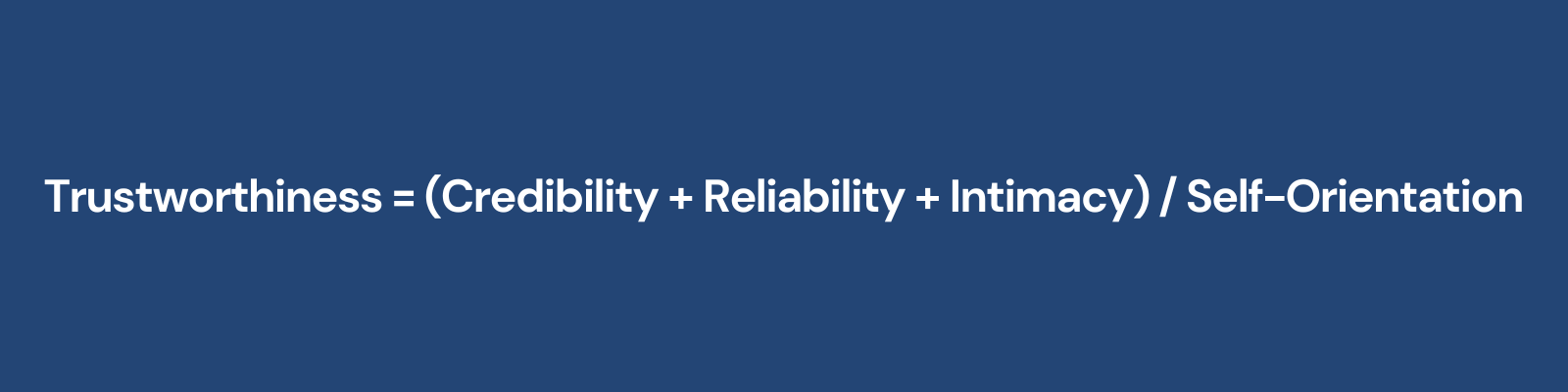
No matter how credible, reliable, and intimate a person is, they undermine all of that if they care about themselves so exclusively that they fail to show interest in other people.
By walking into social situations preoccupied with self-oriented questions, not only are we internally generating debilitating thoughts, we are also externally creating the conditions for people to respond untrustingly towards us, which only serves to make social interactions more difficult, providing further temptation for self-orientation.
It is admittedly a harsh, reinforcing downwards spiral and a really horrible place to be stuck.
But, here’s what helped me get out of this bind: When you realise that it is just a matter of re-orienting yourself towards others, you realise that it has nothing to do with your character or your misfortunes. It is not that you lack talent, confidence, caring, or experience. It’s not that you have bad social skills, or that you have nothing to contribute, or that there is anything broken or lacking in you at all. It is simply that you have gotten into a pattern of thinking about yourself too much.
The good news is that if it is a pattern, you can change it by deciding to practice something new! You really can transform your social life and make all the anxiety, doubt, and self-loathing go away by choosing to become more interested in others. You don’t need a therapist. You don’t need to become “a more interesting person.” You don’t even need to learn any new skills (besides maybe sharpening your skills in questioning). You just need to reframe social gatherings as opportunities to make other people the heroes of the story—and forget about yourself for a couple of hours.
When you make someone else the subject of your sincere curiosity, you’re doing some very powerful, mutually beneficial things:
First, since you’re investing your time and everyone knows time is precious, you are signalling that you value them. You may be the only person this year who has looked at them for more than five seconds or asked them three consecutive questions beyond “How are you?” and “What do you do?” This alone can give people big boosts of self-esteem as they recognise that someone else finds them interesting enough to want to know more. They will not forget about this kindness and they will want to pay it back. And as for you, and your old worries about rejection, you will now be standing firmly in the realm of nice person—a nice, curious person who they’ll want to spend more time with.
Second, you’ll be demonstrating humility, which is a likeable quality in itself. But it’s more than that, since being humble also helps you to deepen the relationships you are building. This has to do with trust again. Studies show that trusting others first actually increases our own trustworthiness. For instance, think back to interactions you’ve had with people who were perfectly nice but didn’t ask you a single question, or showed absolutely no signs of doubt or fallibility. Did they feel trustworthy? I doubt it very seriously. Contrast that with someone who went first in volunteering something they were struggling with. The fact that they trusted you to hear their uncertainties likely made them trustworthy. Chances are you were touched that they felt safe to confide in you, and you naturally wanted to reciprocate. Asking questions is a version of this trust that earns trust, because to openly ask questions is an act of vulnerability, since we are socially vulnerable when we are not in the know. By asking questions, we are effectively saying, “Hey, not only do I find you worthy of my time, I am also trusting you not to penalise me for being ignorant.”
For a whole host of reasons, then, asking people questions turns you into a trust magnet, making social interactions smooth and inevitable, both of which are unlikely if you show up incuriously self-oriented.
In sum, difficulty greeting people and being sociable is not evidence of any skill gaps or character flaws, but a habit of being too self-absorbed. By choosing to focus our attention on the lives of other people, we create the inner and outer conditions for natural sociability, by earning people’s trust and giving them the license to be curious in return. It is also just much more interesting to show up like this generally. Other people are the most fascinating things in the world.
I mentioned that being curious about others goes hand-in-hand with asking quality questions. There are lots of great books and talks I have binged on to learn how to become a better questioner. You could also start collecting quality questions and keeping them in a library. Or you could work on projects that require you to ask questions often, like interviewing people for podcasts, facilitating oral history, doing some guerrilla journalism, or, like me, finding people to coach.
One tactic that has really helped me feel confident—even excited—walking into rooms full of strangers is to come up with 2–3 things I would genuinely like to learn about someone before I arrive. At first this felt weird, like I was being calculating or performative. But that’s bullshit. Taking the time to determine what you find most intriguing about other people is in fact deeply caring, considerate, and generous, and it’s the best method I know of being comfortable in my own skin.
⬥
Hey, it’s Harrison 👋 Thanks for reading my publication.
Do you know roughly what you want next but have no idea how to get in front of the right people without looking desperate? I'm launching a small group coaching programme called Screw the Job Boards to help you build genuine relationships with the companies you actually want to work for, and make yourself the obvious choice. If you’re interested, check it out.
Previous post

Your post beautifully reflected my early adult years. With rare exceptions I was constantly worrying about how I was coming across to people. I know I came across well enough but I also know people found it hard to trust me entirely. They wondered "what's your deal exactly?"
That was the problem. My deal was me and my self-esteem.
I want to say it was easy to make the transition from teenage-esque self-absorbtion and a more compassionate, other-oriented self. It wasn't nor was it especially intentional. It was largely accidental. Well probably not. I think my response was the choice that made all the difference.
As result of realizing I didn't enjoy owning a business AND my dad passing away I lost two "anchors" for the way I defined myself and my response, fortunately, was to begin doing a lot of spiritual practice that helped me realize that, actually, there was a much larger reality and that I actually DID matter.
I began to own at a cellular level that my awkwardness didn't matter that much. In fact, I realized my awkwardness often put people at ease and gave them permission not to feel compelled to be "perfect." And if I could be awkward I could also ask questions which might or might not sound stupid.
Being curious at a child-like level and feeling good about asking questions has opened up a lot of relationships and opportunities for me. I enjoy other people a lot more and they enjoy being with me (which is really nice).
More I could share here but this is quite a bit and it feels complete.
Love this article, thanks for sharing.
It fits in with a realisation I had a while ago which really helped shift my perspective/helped me with social situations:
Everyone is mainly doing what you're doing, i.e. they're wondering if people like them, what people think of them, that is that they're thinking mainly of themselves, not about you.
I found that an enormously freeing thing to realise and start to truly believe.