


Dear subscribers,
This month I began my International Coaching Federation Accreditation to become a Certified Positive Psychology Coach. Fuck yeah!
As a result, I’m learning a shit ton of new brain-busting stuff about “the science of flourishing,” and I’d love for you to indulge me by letting me get some of this stuff out of my head and onto paper as it helps me learn and remember it.

The big headline to share immediately is that I, you, and probably most people you’ve ever known have only understood half of psychology’s potential. Psychology emerged as a discipline in the late 19th century. Its original role was to study what goes wrong AND what goes right with people, so that we could do more of the good and less of the bad.
However, after the two world wars, there was a sudden, acute need for psychologists to step in and help all the wounded and disturbed soldiers returning from the front lines, many having lost limbs or witnessed comrades getting killed. Lots of psychologists figured out they could make a good living doing this. Most of the funding for research went into this too. The result was that the discipline of Psychology came to focus predominantly on studying people’s problems: their mental difficulties, disturbances, distresses and dysfunctions. In other words, Psychology’s job became fixing people.
Out of this grew the DSM, or the Diagnostic and Statistical Manual of Mental Disorders1. This taxonomy allowed scientists to identify, organise and study mental illness. It ensured they were all singing from the same hymn sheet, enabling collaboration and scientific progress. Every scientific discipline has proprietary methodology like this. And if you’ve ever been to see a counsellor, therapist or other mental health professional, they almost certainly used the DSM to diagnose and treat you.
But in the 1990s something changed. An eminent Psychologist called Martin Seligman was elected President of the American Psychological Association, and he made it his personal mission to resurrect the positive side of the profession. That is to say, he threw his weight behind the idea that there was a LOT that human beings did well, a LOT they had learned about living the good life, and all of this could be used to help more people become increasingly well-adjusted.
Seligman gave a resounding cry for Psychologists everywhere to spend more time studying how to help people develop strengths and continue doing more of the stuff that made them flourish. Hence the birth of the Positive Psychology (PP) movement. Seligman and his followers have since been putting PP on the map and establishing a language and set of methodologies of their own—as well as generating much more research funding—to help make PP a serious subject of scientific study that can help to make all of us happier and more effective.
I think it’s important to mention another reason Psychologists prior to Seligman focused exclusively on fixing mental illness: it had to do with the fact that when faced with impending pain vs. impending pleasure, we have a natural instinct to want to soothe the pain first. “Pain killers sell better than vitamins” goes the popular maxim from the business world. When you think about it like that, it’s not altogether surprising that addressing pain became a priority after the bloodshed of two world wars.
However, an important point here is that, for many of us in the cultural west today, we are no longer living in war zones, and this presents us with an opportunity to shift our focus back to the positive side of the psychological equation. I might even call it a moral obligation, as surely we ought to make hay while the sun shines, no?
I am aware that there are still wars being fought in various parts of the world and I’m not being ignorant or insensitive when I say we’re no longer living in war zones; I’m just making a broader point about the relative safety, happiness, and prosperity enjoyed by millions of people today that was not shared by the people living around 1914–1918 and 1939–1945.
Thanks to Seligman and other enterprising Psychologists who’ve chosen to make the most of their relative freedom, today the focus has shifted back to a more complete picture, and we have a thriving if relatively small and still embryonic branch of Psychology whose stakeholders (including yours truly) are interested specifically in what is going on when things go right with people.

A key part of PP is the study of strengths. There are a few different ways Positive Psychologists (I’m gonna call them PPs) think about strengths. My preferred definition is that “strengths are things we enjoy and also excel at.”
Before I get further into one fascinating aspect of strengths, I want to put down a quick list of important-but-not-in-need-of-major-exposition points about strengths, in no particular order, just to reinforce my comprehension and share insights that help contextualise strengths studies:
We all have strengths. Every person on earth has strengths, and every person has weaknesses too. This is not making value judgments about people’s character; it is being realistic about the fact that each of us was dealt a bundle of unique talents, interests and idiosyncrasies that come together to create a kind of strength signature as unique as a fingerprint.
We should beware of strengthening weaknesses. Contrary to popular advice, a growing body of research suggests that we are better off developing our strengths instead of developing our weaknesses. Think of it like this: I am nowhere near as service-oriented as my wife is. For me to even come close to being as effective as she is with that strength, I would have to invest a ridiculous amount of time and effort, reject most other things in my life, and in the end I wouldn’t even enjoy it; whereas, she loves it and doesn’t have to try hard to be good at it. It wouldn’t make sense, then, for me to dedicate so much of my life to something I neither enjoy nor will ever master, while letting my true strengths go un-fully-realised.
We find it hard to talk about strengths. Many people are raised in environments (families, schools, friends, organisations) that lack an adequate vocabulary and impetus for discussing strengths. Indeed, many of these environments are generally criticism-oriented; parents, teachers, friends and bosses likely spend more time pointing out what you do wrong, or complaining about the errors of the world, than they do waxing lyrical about your strengths and virtues.
We are constrained when discussing strengths. Many other social and cultural factors constrain our willingness and ability to discuss strengths, including the role of humility, a lack of feedback, strengths blindness, culturally-specific beliefs about the importance of “fitting in,” and the concept of the fixed mindset (ie, the notion that our strengths are fixed and cannot be developed further).
Consistent with our inbuilt radar for seeking out problems and avoiding imminent pain, we have created a world where it’s more common to pull weeds than sow seeds.
BUT, this is where PP comes in, because it turns out that some very interesting, enlightening and exciting things happen when you choose to ignore weaknesses, errors and shortcomings, and instead start poking around in the positive recesses of people’s minds.
Consider the process of expanding your strengths vocabulary. Below is a snapshot of my growing strengths library. Whenever I come across a strength, i add it to the list along with a pithy definition. The benefit of this is that by having a bigger vocabulary, I can have richer, more meaningful and ultimately more useful conversations with the people whose growth I care about, which is basically everybody I know, but more specifically my wife, my mum, my coaching clients and my friends.
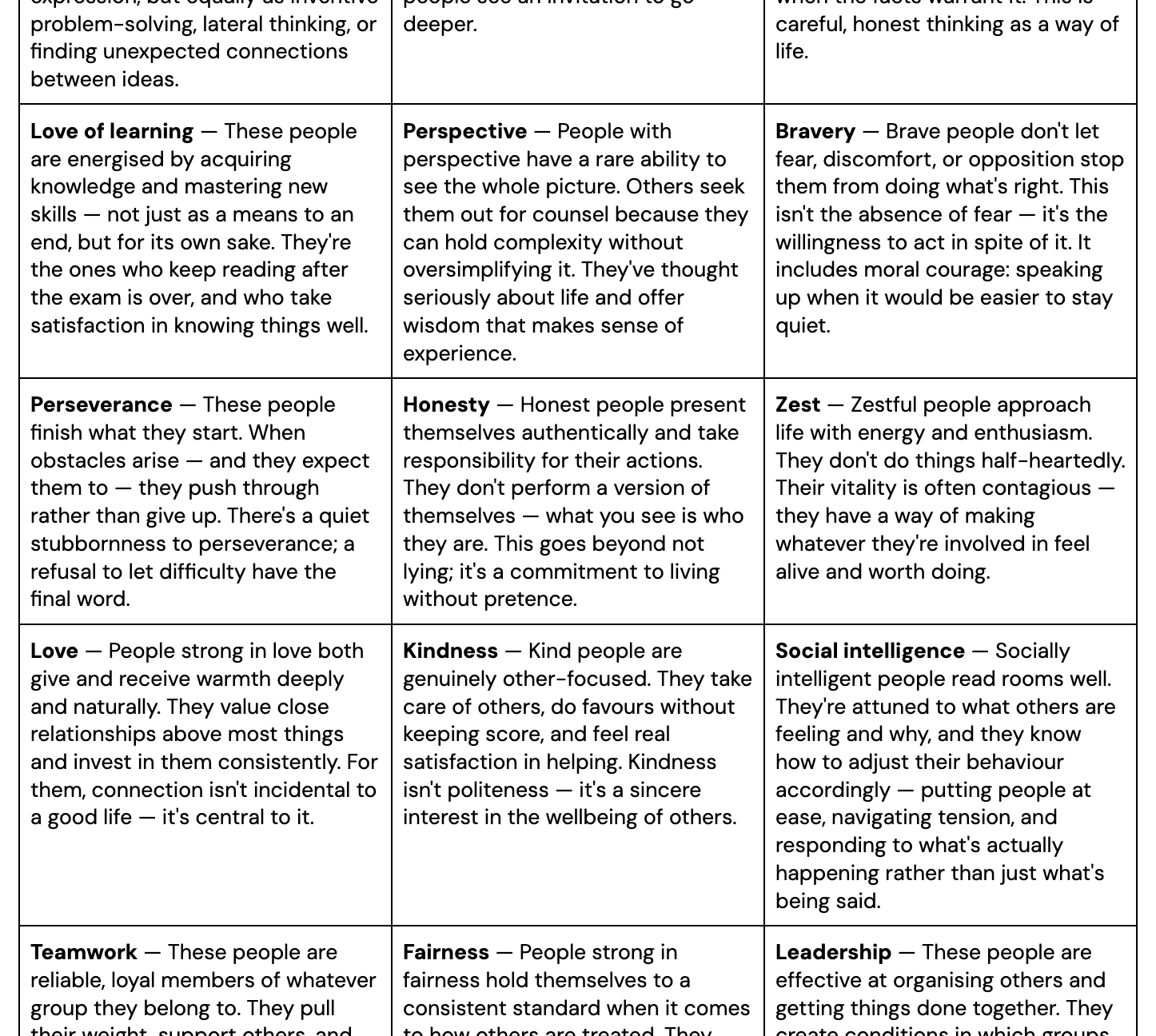
I have only had a few overly excited conversations about strengths-spotting with my wife and a few clients so far, and I still have a long long way to go in understanding how to facilitate valuable strengths-based conversations.
But notice what happens inside you as you hold a strength of yours in mind and read the following strengths-curious questions. I would wager that you feel some positive emotions as you imagine being asked these questions about your specific strengths.
What do you think about the particular strengths labels you have?
What is your unique understanding of how your particular strengths manifest in you?
How much do you like the strengths you have?
How much do you feel your strengths are part of your identity?
How have your strengths shown up best in your life? And where would you like to aim them next?
The reason engaging with questions like these feels freeing and generative is that it’s so novel to be asked them! We simply have not been given many (or any) opportunities to name the things we enjoy and excel at, claim them as our own, and have supportive, thoughtful, exploratory dialogue about their implications for our lives and the lives of others.

Approaching life from the POV of strengths identification and discussion is a profound shift, a shift that is already yielding some lovely surprises.
For instance, while writing the definitions of the strengths in my library, a few strongly reminded me of people I know. I felt emotional seeing those familiar people in my mind suddenly in higher definition, as if I was seeing them fully for the very first time. I felt simultaneously grateful to them for their unique gifts and guilty that I’d spent much of my life overlooking them.
What about the people in your life? Who have you not seen fully yet?
It is exciting to continue practicing spotting people’s strengths (as well as my own) and exploring what roles those strengths can play in building a life that’s genuinely yours.
I’m also excited to learn how to have powerful strengths-based conversations. And to that end, the good ol’ PPs have provided various frameworks for doing so. They are fascinating. Let me share five that resonated with me most:
1. Conversations about Strengths Constellations
The idea of strengths constellations is that our unique strengths can be combined to make powerful compound strengths that allow us to do things we didn’t think possible until we’d linked then together. Put another way, if you consider a strength like grit, for example, you may find that it’s actually a combination of several of your other strengths like focus, optimism and hope. To explore constellations, first identify a number of your strengths, then reflect on the potential inherent in combining them. Get curious about the constellations of your nearest and dearest as well. It’s exciting to explore what people are truly capable of.
2. Conversations about Strengths Blindness
Strengths blindness is one of many reasons our culture tends not to foster conversations about strengths: we take our strengths for granted and believe they are ordinary instead of extraordinary. We’ve all experienced those curse-of-knowledge moments where we assume everyone has the same ability as us but then they turn around and say, “Wait a minute, this is easy for you because you’ve done it loads, but I haven’t!” Strengths blindness is a similar oversight. Because the things we enjoy and excel at are easy for us, we forget that they are strengths. But ask yourself: what would be newly possible if you regarded your own strengths with the same reverence you extend to strengths in others?
3. Conversations about Strengths Sensitivity
Strengths sensitivity is about anticipating and embracing the failure that comes with developing our strengths, and learning how to calibrate when, where, and with whom to use them. For example, let’s say we try something new (eg, interviewing a customer) using our strengths (curiosity, powerful questioning, social intelligence) but it doesn’t go to plan. We fall. We fuck up. Maybe we forget to record the interview. In this scenario, it’s tempting to chalk it up as evidence of weaknesses. But that would be wrong. That would be conflating the strengths with the outcome. Instead of walking away feeling like a failure, we can give ourselves permission to make mistakes as we grow, and we can learn how to adapt our strengths to fit different situations.
4. Conversations about Social Cost
Conversations about the social cost of strengths can be especially fruitful ones. They stem from the fact that when we use our strengths in the world, they affect people, and different people react differently to them. Some excellent questions to explore the social cost of your strengths—and gain insights into how to use them even more effectively—are: How do other people react to your strengths? What do you notice about who loves a particular strength of yours? Who else clicks with that strength? Who is that strength most effective with? Who else shares that strength? And conversely, who reacts poorly to your use of that strength? What might you do differently with them?
5. Conversations about Strengths Tilt
Strengths tilt conversations focus on how the social and cultural contexts we’re in shape our perceptions of and use of our strengths. For example, studies have shown that boys and girls in the top percentile in math ability tend to diverge in their career choices down two distinct paths. When the boys become men, they tend to take up jobs in practical, problem-solving, engineering-type roles; whereas, when the girls become women they tend to take up jobs in more relational, community-centric roles such as the social sciences. So, whilst we all may start out with similarly raw skills, talents and proclivities, there are powerful unseen forces precluding and promoting our choices.
So, Positive Psychology is awesome. It’s blowing my mind. I can’t think of a satisfying conclusion as this was just a way for me to recall ideas and produce something so I could learn more effectively.
Thank you for giving me a space to do that. It has helped! And thank you for taking the time to read it. I am very excited indeed about what’s possible with Positive Psychology!
⬥
If you are ready to make a major career shift through a creative project, I offer professional 1:1 coaching—using principles of Positive Psychology—to help you navigate that transformation. Clients have delivered speeches, launched podcasts, started businesses, and found more fulfilling jobs.
If you’re interested in exploring what you could achieve by partnering with me, you can send me an email and we’ll set up a call to chat.
Related post

https://en.wikipedia.org/wiki/Diagnostic_and_Statistical_Manual_of_Mental_Disorders
Something I especially appreciate about positive psychology is it's focus on human agency. Under most circumstances human beings have choices, the choices may not be desirable but we nonetheless have choices. We have agency to shape events. I greatly prefer this framework to the Victim Drama framework in which we are helpless victims in the face of all kinds of events we have no control over. In myths heros have to deal with the unfair, capricious decisions of gods and their choices are what make them heroic.
Love the idea of strengths-spotting and talking about strengths openly.
The list you share is begging to be printed and posted for easy reference!