

You are allowed to ask
What a friend discovered while testing my new communication tool


Last week I saw a LinkedIn post by an old colleague praising an AI-driven app that helps you communicate more effectively with people who have autism.
“From a personal perspective,” she wrote, “this is one of my favourite ever applications of LLMs in tech-for-good. Learning about the Ask Gently App on my commute this morning had me crying with relief. Because simplicity + empathy makes a brilliant product.”
I clicked through to the Ask Gently App and played around with it, and likewise was impressed by how simple and empathic it was. Even without having any experience of the challenges communicating with people who have autism, I knew it was a very useful tool.
The reason AI is well suited to this kind of solution is that the problem is well-defined and can be governed by rules. The language that comes out of Ask Gently goes through a structured transformation: messy input is reshaped according to codified principles.
And since we can pretty faithfully train AI on codified principles, it means we can build tools like Ask Gently that reach millions of people, without them needing to be experts on the principles themselves. The potential impact is massive!

I’ve been looking for things to build with AI and Ask Gently gave me an idea: could I build an AI-driven tool that helped people to communicate non-violently?
If you’re not familiar, Nonviolent Communication, developed by Marshall Rosenberg, is a four-step way of turning angry words into calm, accurate needs and requests. It’s great for reducing conflict and increasing collaboration.
Compare these two statements, for example. Imagine your best friend saying the following to you:
“It pisses me off that we never organise any trips or holidays together. I see groups of friends all the time on holiday with each other. Big groups. Old and young. But we can’t organise shit! All we ever do is blow up WhatsApp and tear each other’s ideas down.”
Compare how it felt hearing that statement with this:
“I’ve noticed we mention holidays a lot but nothing’s been planned for ages. I’m honestly feeling sad about it. I want us to go away and have a proper good time together. Would you be up for meeting this weekend, picking somewhere and setting some actual dates?”
They both essentially say the same thing, but leave a very different taste in your mouth. I’ve said that first example, or something like it, to my mates plenty of times and we’ve still not managed to book a holiday together. Can’t be a coincidence, can it?
I digress.
The four steps that NVC uses to turn blame into honesty (its codified principles) are:
Observe: describe what happened, plainly, without blame or judgement
Feel: name the emotion you felt
Need: find the need underneath that feeling
Request: ask for what would help, clearly and without demanding
I’ve used NVC many times in my life (although not enough). I’ve recommended the book to many people. It’s a great framework. I could sense that its four-step principles could be codified into an LLM, just like Ask Gently.
So, I’ve had a go. This is the first AI-driven tool I’ve built that actually functions and is live online!
To build it, I used Claude Code running in VS Code as the code-writing part, but I had Claude Cowork running alongside as my thinking partner. It was Cowork where I had all my planning discussions and where I designed everything. And it was Cowork that gave me all the instructions to make Claude Code build it.
I’ve called the tool Tempr, which I thought was a great double play on words. It’s a web app you can use on desktop or mobile.
You don’t need to have an understanding of NVC in order to use Tempr; you can just chat to it as normal, and it will do the work for you behind the scenes.
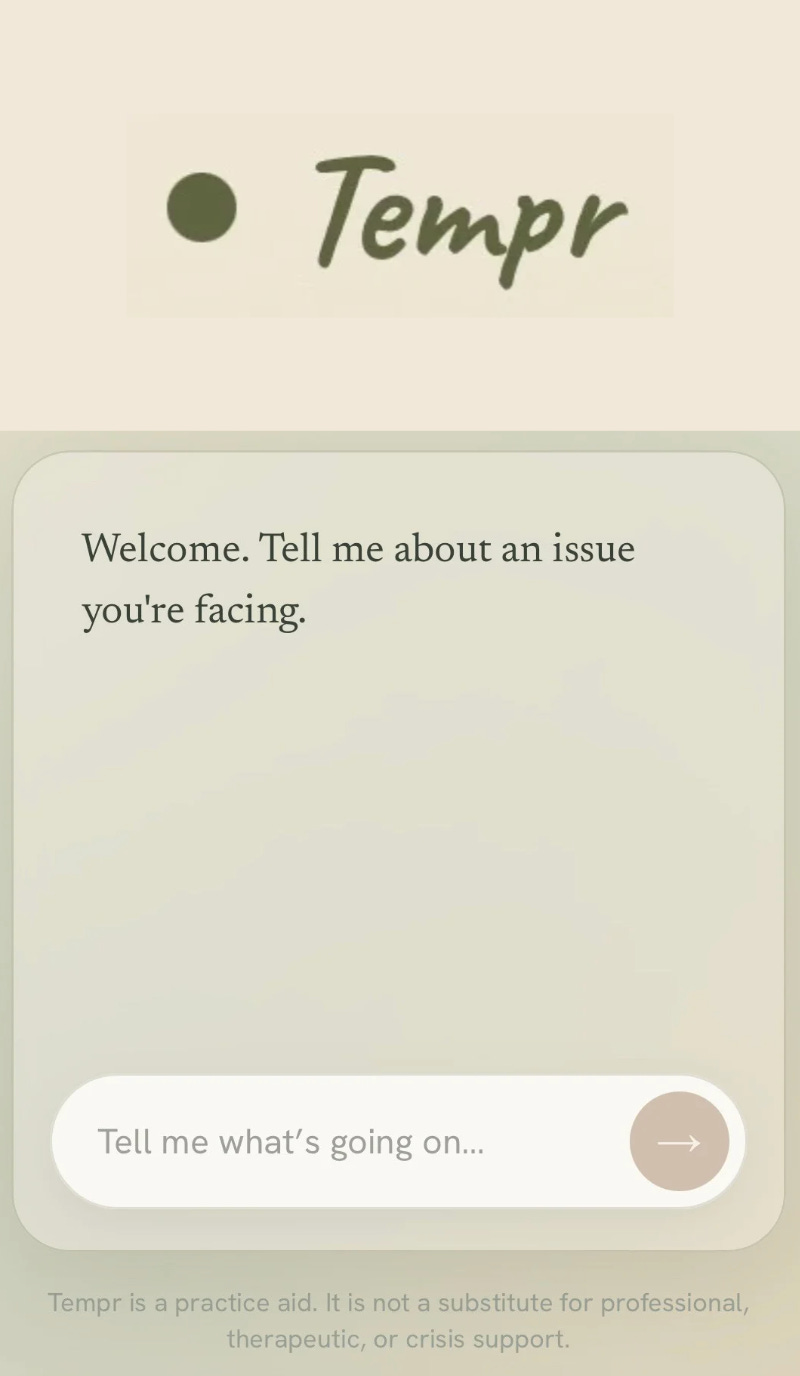
A friend who tested it told me that the output was helpful, but what was even more helpful was realising—through answering the questions—that he was allowed to make a request at all. I think that’s a pretty great outcome!
Right now, I’m looking for early user feedback. If you’re up for trying Tempr, go and have a play. Privacy note: It doesn’t have a database or any storage built in, so anything you share is private to you and lost the moment you refresh the page.
If you do use Tempr, I’d like to ask for two bits of feedback:
How accurate is the NVC language it gives you, and how comfortable would you be using it? I’m not looking for feedback on design or aesthetics at this point, just the substance of what the app provides and how useful it is, if at all.
Additionally, if you’ve got any ideas about how I could get Tempr into the hands of more people without promotional activities taking over my entire life, I’m all ears. I think Tempr could help a lot of people, but the truth is I’m busy, and also, marketing’s not my favourite thing. I’m in that grey area between wanting to promote it but being wary of how time-consuming that could be.
I’m probably not going to keep Tempr live for long, as it’s an experimental tool, so if you’re interested at all, I’d have a go now. It should only need 10 minutes of your time.
Make sure you have a real use case for it (ie, an interpersonal conflict that’s genuinely bothering you), and then email or DM me, letting me know what your experience was like.
What’s the coolest, most impactful thing you’ve seen built with AI?
Have a great weekend!
—Harrison 👨🎨
Strengths coaching ✨
Hey, it’s Harrison, I hope you enjoyed this post!
Did you know that, besides writing, I run a strengths-focused coaching practice for those in career and creative transitions. I’m currently undertaking my ICF accreditation in Positive Psychology under the supervision of Dr. Robert Biswas-Diener, a leading psychologist and scholar on motivation and happiness.
My coaching clients have said they “feel like new career paths have been unlocked that they didn’t know were open to them,” and that they “can build new maps of the future and advocate for themselves with more confidence.”
If you are interested in coaching conversations that can help you become more aware of your own strengths, build a richer vocabulary of your strengths (and those of others!), and learn how to claim and aim your strengths at different parts of your life, get in touch and we can arrange a free 30-min no obligation discovery call.
Read a related post
